A story about three stories
Are you sitting comfortably? I’ll tell you a story that started a journey that has moved, with my career, from simply telling, to storythinking, to neuroscience, to the misty clouds of philosophical thinking where I have questioned if our lived experience is in fact made of story...
A long time ago, in an ad agency far away…
In the spring of 2017, I was working as an ECD in an ad agency in London, twiddling my thumbs a little trying to look busy (much more exhausting than actually being busy) when a colleague knocked on my door and asked me to head up a project for Heineken. Great brand. One for the portfolio. Got nothing else to do. No choice, anyway. I’m in.
The brief was a dream: bring the brand’s global strapline ‘Open your world’ to life. “Beer”, you say? “Travel”, you say? “New experiences…”, you say? It should have been a dream.
The problem was that, in 2017, things didn’t feel very open. In fact, the world seemed to be shutting down. The previous years' shocks of both the Clinton/Trump presidential elections in the US, and the Brexit referendum in the UK had hit hard. The role that the big social platform’s algorithms played in exposure to partisan messaging, as well as bot amplification and the asymmetrical removal of opinions from online debate, was put under the microscope. The phrase ‘echo chamber’ had entered the vernacular.
A strapline gone flat
Making an ad for a 'digital first' beer brand that stood for ‘hey guys, let’s explore this global playground of ours together, like a big happy family, while we meet and mingle over a beer’ was, to put it mildly, a challenge.
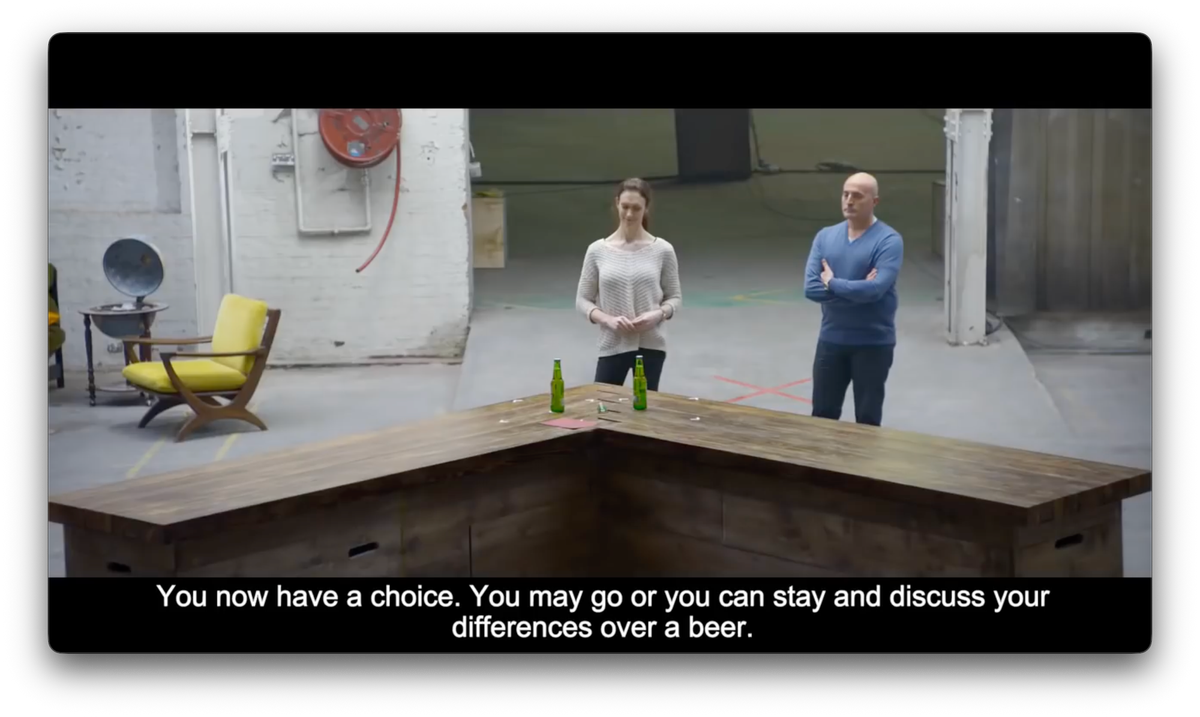
We decided our job was to show the world what it might mean to open our virtual worlds. The concept was simple: Open your world meant showing our audience what happens when we open our minds to another's point of view. At the heart of this, we’d prove that there’s more that unites us than divides us, with a real-life social experiment to get people with polarising opinions into a room, where they’d get to know each other. Then we’d reveal their differences before asking them whether they’d be opening to discussing their opinions (over a beer, obviously).
So we made a film of an experiment that proved that we humans can always find common ground when we open our minds to each other.
A story sold that had to be made
We spent 14 weeks scouting for people with opinions strong enough to prove the point, who were also happy to be part of an ‘blind’ experiment. Three days filming in East London. Nine sets of couples with opposing view points. We designed and took them through a series of tasks together. They built stools and then a whole bar. They found asked and answered questions specifically designed to open them up to each other.
The hook came when we then asked them both to watch their casting films, in front of each other. In every film, each individual’s polarising opinion was laid bare. The feminist who’d spent a couple of hours getting to know and get on with a stranger, watched him explain view that “women do really need men… to have our children”. The climate activist heard his task-partner’s view that climate change is “a load of old piffle”, spouted by people who should just get off their high horses…
Then the killer question, delivered over tannoy: “Now you have a choice. You can leave. Or you can stay to discuss your differences over a beer.”
Despite being an ad, it was also a real, authentic social experiment. In the real-life filming, with only a flimsy partition between me and the hesitant reactions of two real people, it was brutal. The most nerve-wracking shoot I’ve ever been on.
We didn’t know what they’d do.
Some left us guessing for what seemed like hours instead of the actual seconds that they paused for. But eight of the nine pairs agreed to stay and discuss. It was a powerful validation of both the concept designed to make sense of a global beer brand’s tagline as well as its insight - our human need for, more than anything, connection.
But that triumph paled in the headlights of a forensic, two-week edit. We cut well over 100 hours of footage to four and a half minutes. The client kept pressing: “90s is what we agreed, 90s is what you’ll deliver”.
"But," we pleaded: “it’ll take us a couple of days to get to the final 90s cut. Can we upload the 4min 30s version and replace it with the one you want...”
Within three or four days, the film had been watched tens of millions of times - all around the world. Global news picked it up and the views and shares kept climbing. Some colleagues liked it, many didn’t, the industry press hated it. Similarly, the film got lots of support and piles of criticism online. (One of the best bits of the experience was seeing the comments that popped up between heated debates about good or bad the ad was, to suggest that the antagonists just “have a beer and discuss” their points of view…)
From a reach point of view, Worlds Apart became Heineken UK’s most successful campaign. It won some creative and effectiveness awards, too, which was nice. Not bad for a film about different people getting to know each other - a simple story of three stories.
The return of the Story…
A few years later, an old colleague put something on LinkedIn about it. I was surprised given the time elapsed and given adland’s unwritten rule that, even if you’ve made memorable work, other people need to do the remembering.
But he didn't write about the campaign itself. Apparently, our film was at the centre of a Stanford megastudy on reducing partisan animosity. The film was proved to have resulted in respondents seeing that there is indeed more that unites us than divides us. Of all the questionnaires and workshops that went into the study (252 submitted, 25 chosen to test) our little story of three stories, was scored to be the most effective way to change the way that other people thought, so that they were open to doing the same.
But... why story?
A film that tells a story about people opening up had been proven to create the same effect in a megastudy of over 30,000 strangers. In my work in advertising communications and with leaders of large and complex businesses, I've seen the power of stories to drive collective action time and again.
The power of story telling is well documented by many. The question: "Why should someone else's story move me and my team to act?" less so, and it's the one that SharedMinds is focused on. Because, if we can answer that, then I believe we can unlock something for ourselves - and others - that’s uniquely, powerfully human and something that can bring us together with real meaning.